
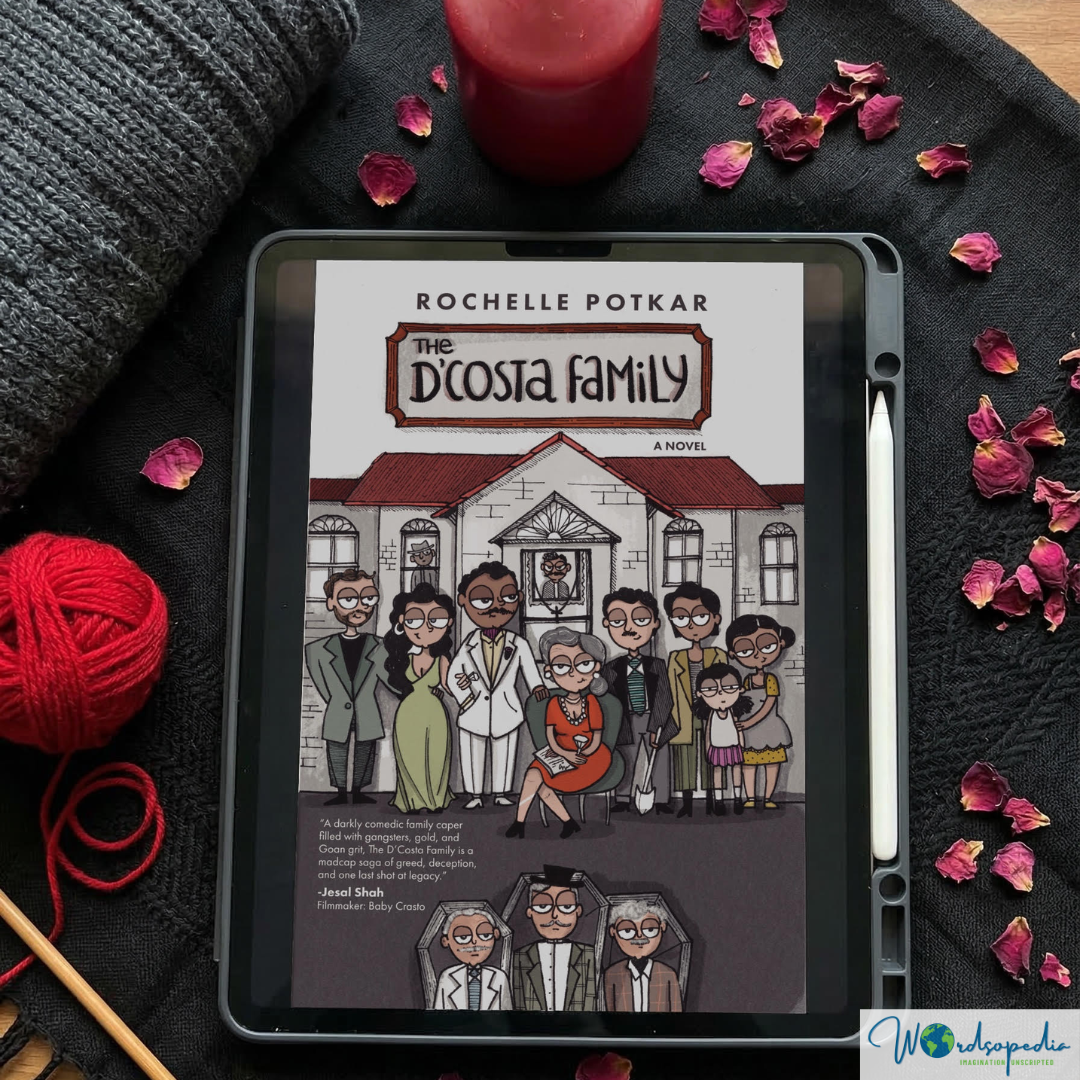
Have you ever had so much fun meeting a fictional family that you wanna meet them irl? For me, it was Rochelle Potkar’s The D’Costa Family. This dark, comic Goan Catholic household is full of gangsters, greed, and secrets buried deep. Having first read Potkar’s short story collection Bombay Hangovers, I can say her precision and feel for language are here too, stretched across a longer, wilder canvas.
⚡ The Quick Take
The Vibe: Succession meets The Godfather, but in a sun-soaked, rain-drenched Goa.
Best For: Readers who love dark humor, complex women, and atmospheric Indian noir.
Key Takeaway: A sharp, fragmented exploration of a Goan Catholic family in freefall. Despite some pacing stumbles, it’s a masterclass in writing women and power.
Wordsopedia Verdict: 4 / 5 Stars ⭐⭐⭐⭐
What is The D’Costa Family about?
Don Theodore D’Costa of Burgundy House, Goa dies, and that is where the real trouble begins.
Theodore wanted his elder son Don Pedro to inherit the Don’s title. His widow Rita has no intention of honouring his wishes; she has already decided it will be Jason — her favourite, her project. From bribing tenants to dismantling her dead husband’s authority, Rita’s ambition is the engine of this Goan Catholic family saga.
Around this power grab, the Burgundy House is in chaos:
Annette: The pregnant daughter-in-law with a secret lover.
Inspector Gaitonde: My favorite character, who discovers that something is literally buried under Jason’s graveyard.
The Family Feud: A Catholic-Hindu wedding falls apart as old rivals resurface.
A Mosaic Style of Storytelling
This is not a linear story. It moves in fragments — short scenes, sharp cuts, one vignette handing off to the next. Think less family saga, more literary mosaic. Each piece reveals a corner of the D’Costa world: a conversation that shifts an alliance, a look across a dinner table that says everything nobody will say out loud.
What struck me is how much the novel communicates through silence. Dialogue is spare, and the white space between scenes does real work. For a dark comedy this loud on the surface — gang wars, gunshots, stolen jewellery — the interior of the novel is surprisingly still.
The Women and Power in The D’Costa Family
At its heart, this is a novel about women and power. Rita D’Costa is extraordinary: manipulative, calculating, and occasionally sympathetic. She understands the rules of a world designed by men, and she uses them to her advantage. Annette, her daughter-in-law, is quieter but no less fierce. The two of them circling each other is the best dynamic in the book.
Potkar never makes a “speech” about any of this; the women are simply at the centre, and the novel proceeds from that fact.
The Dark Humour and Prose
I laughed more than I expected to — the uncomfortable kind of laughter where something is wrong and funny at the same time. At Don Theodore’s funeral, it’s evident that some came to grieve, while others came to “confirm.”
Potkar’s prose is character compressed into image — like the detail of Rita’s talcum-dusted neck or Jason’s graveyard rituals. She captures the specific Goan Catholic life — its Portuguese inheritance, its relationship with caste, and its unique rhythms of speech — with complete specificity.
What didn’t quite work for me
The first half is genuinely crowded. Too many characters arrive too quickly, and I found myself flipping back to keep track of who mattered. A little more anchoring early on would have helped.
The pacing also stumbles. The novel runs fast, then slows, then picks up again. Additionally, Don Pedro — the man whose inheritance is at the center of the conflict — remains oddly distant. Given how richly Potkar can write a character, the thinness of the male characters felt like a missed opportunity.
❖ The Highlights
The fragmented structure: Shards and vignettes that mirror an unstable family.
The dark humour: Macabre, precise, and entirely Potkar’s own.
Goa, rendered fully: A Goan Christian community rarely given this much specificity in Indian English fiction.
The women: At the centre of everything, without ever making a speech about it.
❖ The Hiccups
Too crowded, too soon: The first half throws characters at you faster than you can hold them.
Uneven pacing: The lulls land hard in an otherwise fast-paced thriller.
Subplot discipline: The structural ambition occasionally outpaces the editorial focus.
The D’Costa Family is chaotic, scheming, funny in the darkest ways, and absolutely worth your time.
This review reflects my honest and voluntary opinion.