
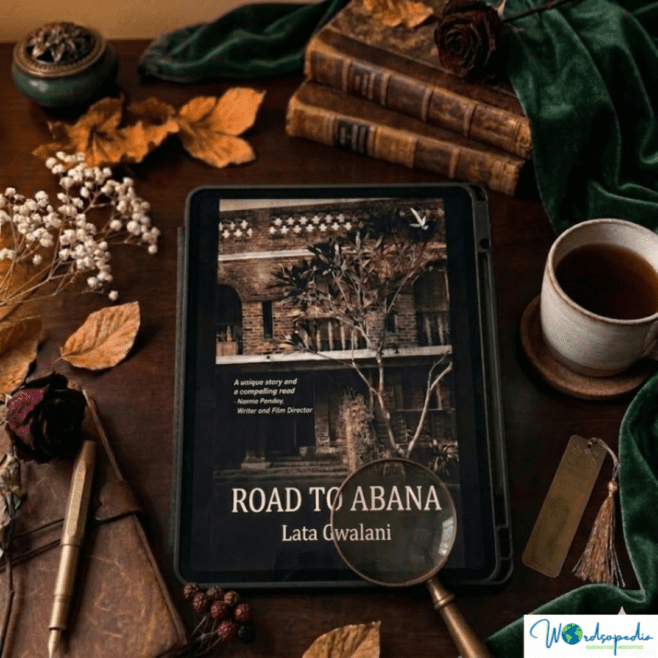
Have you ever wondered if “home” is a place you leave behind, or a place that refuses to leave you?
For many of us, Partition isn’t just a chapter in a history book; it’s a living, breathing ache passed down through generations. In Road to Abana, Lata Gwalani takes this collective memory and narrows the lens to a single, tenacious woman’s journey. While many stories of this era focus on the immediate chaos of 1947, this novel explores the long, simmering displacement that persists decades later.
⚡ The Quick Take
The Vibe: A gritty yet emotionally resonant historical journey bridging refugee camps and dangerous borderlands.
Best For: Readers of literary historical fiction who appreciate strong female protagonists and stories of the Sindhi diaspora.
Key Takeaway: Gwalani explores the “why” of returning home through a lens of extreme resilience and evocative prose.
Wordsopedia Verdict: 3.5/5 ⭐⭐⭐✨
What Is Road to Abana About?
The narrative begins in the squalid, hopeful, and heartbreaking reality of the refugee camps in Ulhasnagar, Bombay.
Paari is a Sindhi woman whose life has been bifurcated by the 1947 border. But rather than remaining a passive victim of history, she becomes an active participant in reclaiming her sense of place. Her journey takes her from the stagnant atmosphere of the camps into the high-stakes, dangerous world of arms trafficking as she navigates the treacherous terrains of Karachi and Afghanistan. It is a story of a woman willing to walk through fire—or across hostile borders—to find “Abana” (home).
The People in Paari’s World
Paari: The heart of the story. Her arc is defined by an unwavering, almost steely determination. She is courageous not because she lacks fear, but because she knows it so closely she can “walk right through it.”
Paari’s Father: One of the most moving portraits in the book. Their relationship is anchored in a shared sense of loss and a quiet, mutual understanding that drives much of the emotional stakes.
Virmal: A character who embodies the internal “litmus test” of the heart, caught precariously between duty and desire.
Narration, Pacing, and Style
The story maintains a steady flow, transitioning from the internal grief of the camps to the external high-stakes tension of smuggling. The pacing mirrors Paari’s urgency, though the middle section occasionally gets weighed down by the logistics of her travel.
Gwalani’s writing is well-crafted, featuring an evocative vocabulary that brings the dusty streets of Sukkur and the dark alleys of Karachi to life. The character sketches are simple and clear, focusing on raw emotion rather than unnecessary complexity.
The prose is peppered with introspective gems that I found myself highlighting:
“Fear is so much a part of me. It’s the one thing I know closely. So close, that I can walk right through it, and meet courage on the other side. I am courageous because of the fear.”
My Thoughts
While I deeply understood the sentiment of wanting to go back home, I’ll admit the core idea of the book felt a little light for the journey. Considering the extreme risks Paari takes—crossing hostile borders and entering the world of arms trafficking—the narrative weight of the “why” sometimes felt thin compared to the sheer gravity of her actions.
I also couldn’t help but notice a gap in the family dynamics. The sister and her family are never mentioned, and curiously, Paari is never shown to be missing her. In a story so rooted in the concept of home and belonging, this lack of sororal connection made the familial landscape feel slightly incomplete.
❖ The Highlights
The Resilience: Paari is a powerhouse protagonist whose determination is infectious.
The Evocative Prose: Gwalani’s ability to describe the physical and emotional landscape of Sindh is top-notch.
The Father-Daughter Relationship: A delicate, memorable portrayal of shared grief.
The Writing: Precise, poetic, and never overdone.
“Those we love, don’t go away. They walk beside us every day. Unheard. Unseen. But always near. Still loved. Still missed. And very dear.”
❖ The Hiccups
The “Why” vs. the “How”: The heavy risks sometimes outweighed the narrative justification for the journey.
Missing Family Links: The absence of the sister’s storyline leaves a gap in the emotional map.
Internal Conflicts: At times, the psychological struggle (like Virmal’s) felt more compelling than the physical journey: “One sits on the mellow wings of love, and the other hangs precariously on the precipice of betrayal.”
My Verdict
Road to Abana is a poignant exploration of how Partition breaks an individual and how they try to mend themselves. It serves as a reminder that anticipation is indeed the “litmus test of a heart’s tenacity.” Gwalani’s evocative style makes this a worthwhile read for anyone who believes that home is, ultimately, a heartbeat.
Frequently Asked Questions
What does “Abana” mean? In the context of the book, it represents the ancestral home or father’s house—a symbolic “promised land” for the displaced.
Is this a good starting point for Sindhi Partition literature? Absolutely. It offers a rare and necessary look at the Sindhi refugee experience, which is often overshadowed by Punjab-centric narratives.
Is there a heavy focus on the thriller elements? While there is arms trafficking and border crossing, the focus remains firmly on Paari’s internal state and her emotional quest.
If you enjoyed this review, you might also like my review of Beneath Divided Skies
This review reflects my honest and voluntary opinion.