
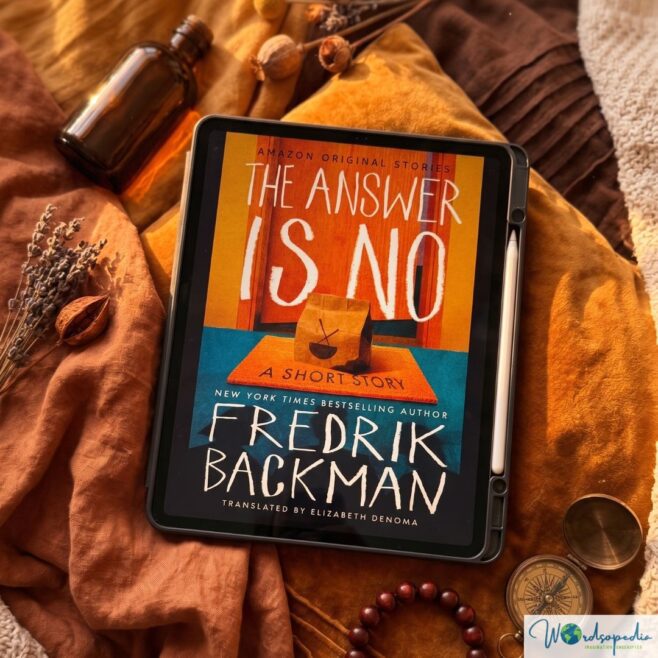
When a book starts with, “It’s a frying pan that ruins Lucas’s life. We’ll get to that,” how can a reader not be intrigued!
Fredrik Backman has this uncanny ability to make you fall in love with the most “other-people-averse” characters. He did it with A Man Called Ove—a story I loved both as a book and on the big screen—and he does it again with Lucas. I have a notorious soft spot for these beautifully grumpy men, so when I saw The Answer Is No, I didn’t hesitate.
I enjoyed this book immensely, both as a reader and as a writer. There is a particular challenge in crafting a short story that feels complete—understanding the nuances of pacing and character economy is no small feat—and Backman makes it look effortless.
⚡ The Quick Take
- The Vibe: A satirical, laugh-out-loud novella about the absurdity of modern bureaucracy and the simple joy of being left alone.
- Best For: Introverts, writers studying short-form fiction, and anyone who has ever survived a neighborhood committee meeting.
- Key Takeaway: Happiness isn’t always about “more.” Sometimes, it’s just the courage to say NO.
- Wordsopedia Verdict: 4.5/5 ⭐⭐⭐⭐✨
Plot Summary: What Is “The Answer Is No” About?
Meet Lucas. Lucas is happy. He has his video games, his red wine, and his Pad Thai. He lives alone, and quite frankly, he’d like to keep it that way.
But the world rarely leaves happy people alone. When that infamous stray frying pan appears in the apartment building’s recycling room, the residence board—a group of bureaucratic busybodies—decides it’s a crisis. What follows is a hilarious, Kafkaesque spiral into community meetings and social pressure that forces Lucas out of his comfortable, isolated shell.
Characters in The Answer Is No: Meet Lucas
- Lucas: A masterpiece of relatable grumpiness. He isn’t lonely; he’s just “other-people-averse.” He views solitude as a prize to be guarded.
- The Board: A perfect caricature of every residence committee you’ve ever encountered—more interested in finding someone to blame than solving the problem.
- The Neighbors: A mismatched group that slowly, and much to his chagrin, drags Lucas into the light of social interaction.
Narration and Writing Style: A Masterclass in the Short Story
From a writer’s perspective, the pacing here is a masterclass. At just under 70 pages, it’s a sprint that moves from quiet domesticity to absolute communal chaos without missing a beat. The narration feels intimate, like a conversation with a very observant friend who knows exactly when to drop a punchline.
The style is classic Backman: simple, clean, and deceptively deep. As a writer, I admired how he used the mundane—like a growing pile of trash—as a potent metaphor for the emotional baggage we all carry when we refuse to deal with our problems head-on.
My Thoughts: The Business of Happiness
One of the core themes of The Answer is No is the commodification of happiness. What resonated most were the philosophical nuggets about the “business” of happiness. Backman’s take is incredibly provocative:
Lucas is happy. This is a very provoking thing to the world. Because people aren’t supposed to be happy, they’re only supposed to want to be happy, because how otherwise are you supposed to be able to sell things to them?
It makes you realize how much of our world is built on selling us cures for a discontent we didn’t even know we had. And then there’s this, a perfect description of the effort required to just… be:
Lucas is happy. It’s not as hard as one might think to become, the hard part is just to keep being it. It’s hard because it’s so easy to get in your head that if you are to be happy, you have to be happy exactly all of the time. And who in the world has the energy for that? Happiness can be exhausting. Honestly, it’s most often enough to just not be the opposite.
❖ The Highlights
- The Craft: A brilliant example of how to execute a tight, impactful short story.
- The Wit: Sharp, dry, and perfectly timed.
- The Satire: A brilliant takedown of neighborhood group politics and social media amplification.
- The Relatability: If you’ve ever ignored a doorbell or a phone call because you just weren’t in the mood for “people,” this is for you.
❖ The Hiccups
- The Format: It’s so short that the reader in me wished for twenty more pages, even if the writer in me knew the length was exactly right.
- The Pivot: The second half leans into a “cult of personality” trope that feels slightly more hyperbolic than the grounded first half.
My Verdict
The Answer Is No is a gem. It’s a sharp, comedic meditation on the paradoxes of modern happiness. Backman proves again that you don’t need 500 pages to deliver a gut-punch of truth. If the world is feeling a bit too loud lately, this is the perfect reminder that sometimes, the most powerful word you own is a simple, firm “no.”
Frequently Asked Questions
- Is this a sequel to A Man Called Ove? No, it is a standalone novella, though fans of Ove’s curmudgeonly charm will feel right at home with Lucas.
- How long is it? Approximately 68 pages—a super fast, engaging read.
- Where can I find it? It is part of the Amazon Original Stories collection.
If you enjoyed this review, you might also like:
This review reflects my honest and voluntary opinion.