
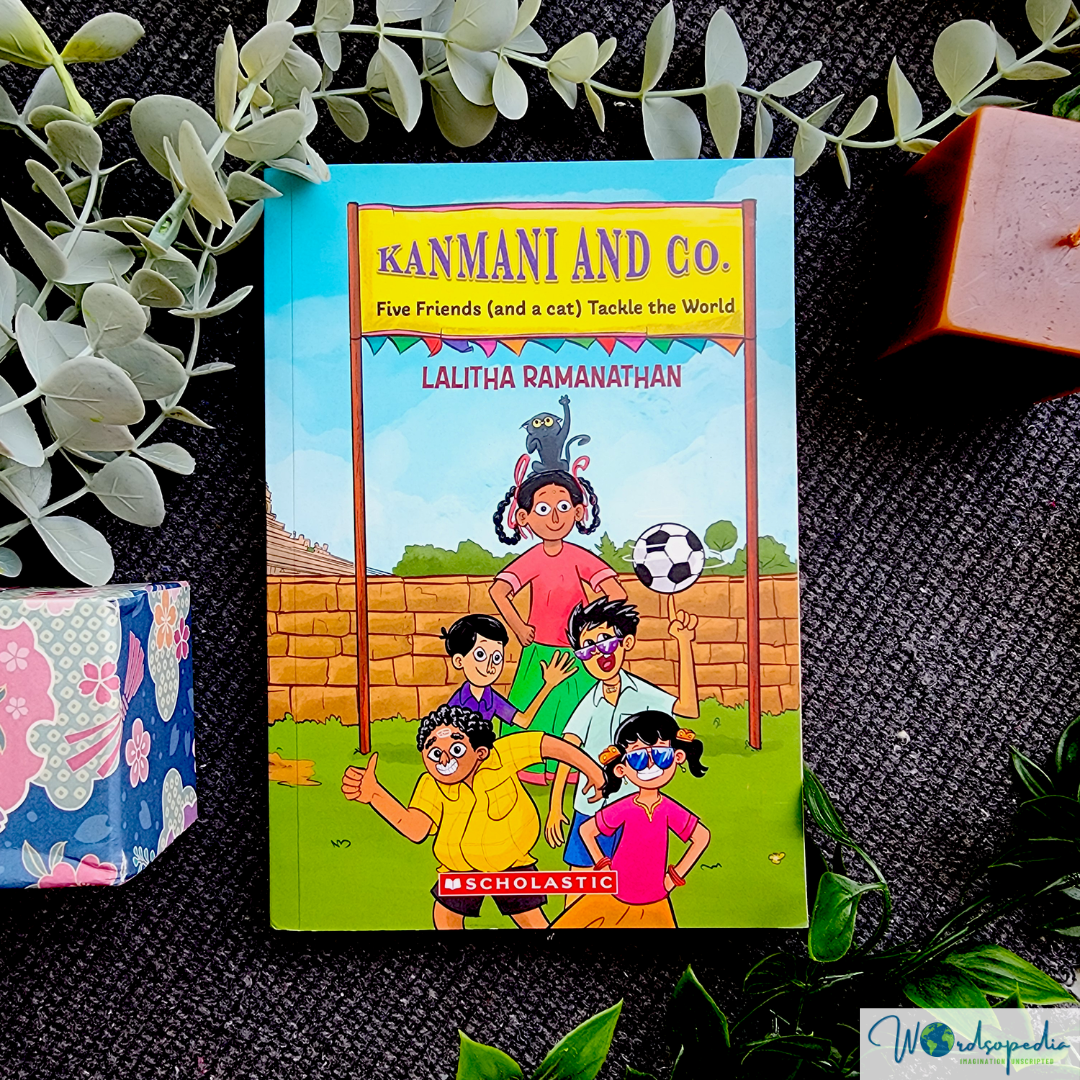
I read Kanmani and Co.: Five Friends (and a Cat) Tackle the World by Lalitha Ramanathan on a flight to Chennai, and I laughed out loud enough times that the passenger next to me asked what I was reading. By the time we landed, I’d recommended it to him and the passengers one row in front and behind and the flight attendant too!
⚡ The Quick Take
- The Vibe: Sunny, nostalgic, and a little chaotic. The kind of summer holiday spent running around outside until the streetlights come on.
- Best For: Anyone who grew up on Malgudi Days or Swami and Friends and wants to hand that same feeling to a kid today.
- Key Takeaway: The book shows children the way they actually think and talk. And that’s the best part!
Wordsopedia Verdict: 5/5 ⭐⭐⭐⭐⭐
What Is Kanmani and Co. About?
Welcome to Maaripuram, where Kanmani, her four friends, and one deeply opinionated cat turn ordinary village and school life into one adventure after another. It’s a story about friendship, mischief, and the small, real problems that matter enormously when you’re nine years old.
The People (and Whiskers) In Maaripuram
Kanmani carries the book, and she earns it. Bright, curious, and always bubbling with a new idea, she cycles to school every day and finds an adventure in the most ordinary places. Her pride gets her into as much trouble as her instincts get her out of. That’s what makes her feel like a real kid rather than a character built to be liked.
I loved watching this gang argue over nothing and then close ranks against the world a minute later. It’s exactly how loyalty actually works at that age.
Seetha is a drama queen who treats every setback like a small production. Sreejith walks with a limp and carries the biggest dreams of the group; including, memorably, scoring the winning goal at his school’s sports day. Subru thinks about food more than anything else, gets teased for his size, and turns out to have more grit than anyone gives him credit for. None of them read like a slot filled in. They read like kids I might have known.
And then there’s the cat. Varam has an uncanny habit of turning up exactly where trouble is about to start, and somehow makes every scene funnier just by looking unimpressed by it. I’m not a cat person. Varam got me anyway.
What really makes it work is the dialogue.
The rhythm of small-town Tamil Nadu comes through naturally. I didn’t just read the conversations. I heard them.
Narration, Pacing, and Story Arc
Lalitha writes at eye level with her characters, never looking down at them from an adult’s height. A dictation test gone wrong or an unfair nickname gets treated with exactly the seriousness a nine-year-old actually feels, and the book never once undercuts that.
The chapters are short, sharply titled, and each one is its own contained adventure — a sports day, a Tamil essay on favourite gods, a village clean-up, a festival gone slightly sideways — tied together by the same five friends. The illustrations do real work too, capturing the kids’ expressions and the cat’s antics as well as the feel of the village itself. It’s an easy book to lose an afternoon to, one chapter at a time.
The Writing
Lalitha has a sharp ear for comedy, and she never dumbs the vocabulary down for younger readers. She trusts them to pick up the cultural context through atmosphere and dialogue, so nothing here reads like it’s explaining India to an outsider. Underneath the humour, she works in real lessons — about literacy, inclusion, breaking gender stereotypes, body positivity — without a single one of them feeling like a lecture.
❖ The Highlights
➤ The Setting : Maaripuram feels lived-in, not sketched.
➤ The Vernacular Voice : local rhythm, no dumbing down.
➤ The Characters : flawed and believable.
➤ The Illustrations : genuinely add to the story, not just decoration.
➤ The Humour : lands for adults just as well as for kids.
❖ The Hiccups
➤ None at all!
Frequently Asked Questions
Is Kanmani and Co. only for children?
No. It’s written as middle-grade fiction, but adults who grew up on classic adventure books will enjoy it just as much.
What is the setting of the book?
Maaripuram, a fictional South Indian village that captures the sights, sounds, and daily rhythm of small-town Tamil Nadu.
Does the book contain illustrations?
Yes — lively artwork by Rahil Mohsin that captures the kids’ expressions, the cat’s antics, and the feel of the village.
What are the primary themes explored?
Friendship, teamwork, literacy, inclusivity, breaking gender stereotypes, body positivity, and community.
My Verdict
Pick up Kanmani & Co. if you want a book that’s genuinely funny, wears its Indian setting without apology, and hands you back some of that buoyant, gang-of-friends energy from childhood.
This review reflects my honest and voluntary opinion.