
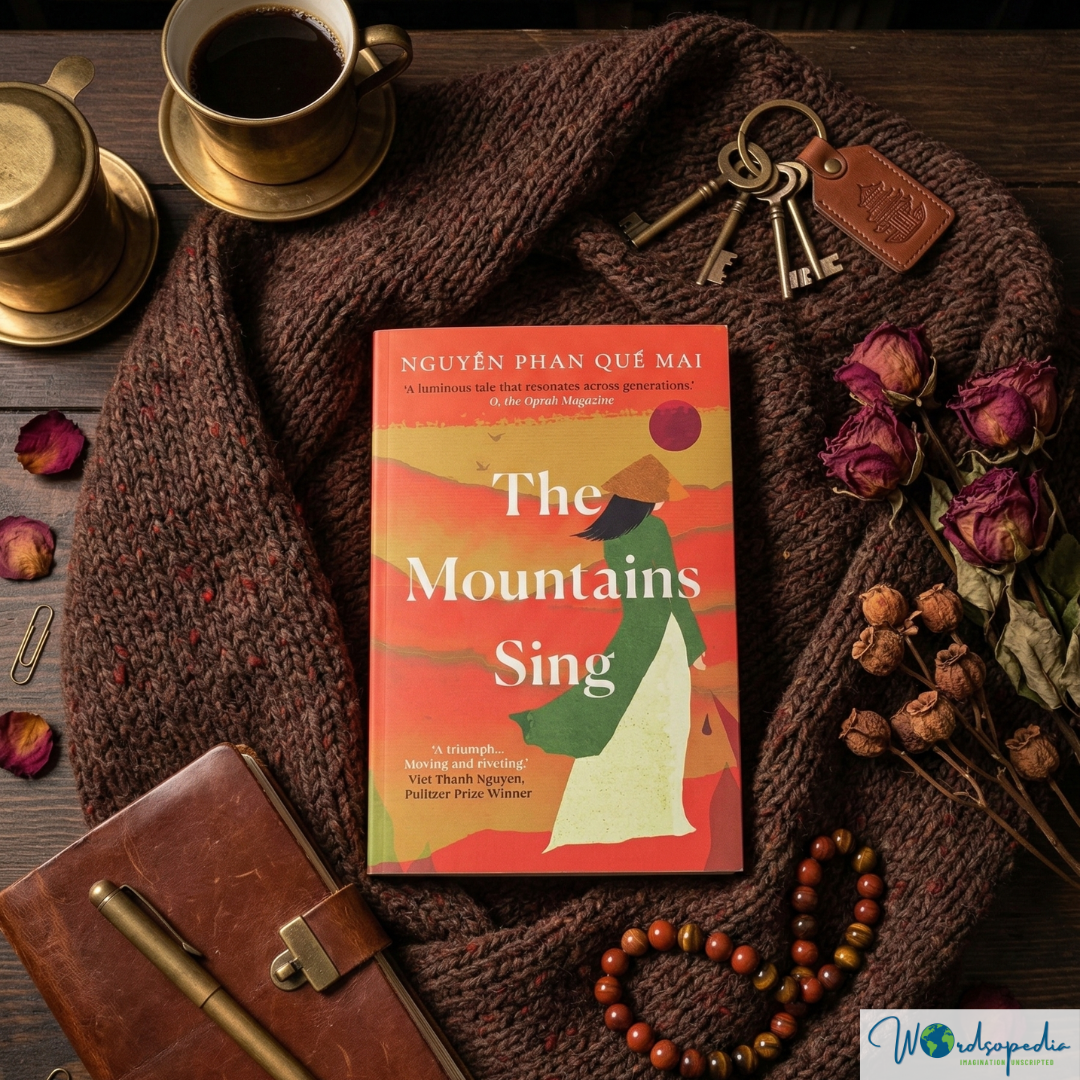
There are authors you read once, and become a fan. Nguyễn Phan Quế Mai is one such author for me. I read Dust Child three years ago and gave it five stars—one of the very few books I’ve ever rated that high. The moment I finished it, I added The Mountains Sing to my TBR. It took a while to get my hands on it. But I am glad the book found me at the right time.
The architecture of the novel
The Mountains Sing is a multigenerational family saga set against nearly a century of Vietnamese history. At its heart are two women: Trần Diệu Lan, born in 1920, who has witnessed it all—French colonialism, Japanese occupation, the Great Hunger of the 1940s, the brutal Land Reform of the 1950s—and her granddaughter Hương, affectionately called Guava, a young girl in Hanoi in the 1970s, listening to those stories while her parents and uncles disappear one by one down the Hồ Chí Minh Trail.
The novel moves between these two timelines in alternating chapters. It’s a remarkable and well-executed structural choice. Diệu Lan’s past and Hương’s present are not just parallel— they are in conversation. What the grandmother survived becomes the light by which the granddaughter navigates her own darkness. The book understands something true about families: history doesn’t stay in the past. It travels forward, person to person, whether we asked for it or not.
What I loved most were the distinct character voices. This is no small achievement. Diệu Lan’s chapters carry an older, measured cadence, almost oral, like someone who has learned to hold grief very still so it doesn’t spill. Hương’s chapters have the rawness of a child still learning what loss means. It’s amazing how Quế Mai keeps the two voices from bleeding into each other, shows the passage of time without losing momentum, and stays connected to the reader through all of it. It is a masterclass in something that looks effortless and is anything but.
Readers who loved the multigenerational sweep of Pachinko by Min Jin Lee or Homegoing by Yaa Gyasi will find something equally immersive here.
The grandmother at the centre
Trần Diệu Lan is the soul of this book. She is one of those characters who stay with you long after the last page—not because she is perfect, but because she is so completely, stubbornly human.
She loses nearly everything, repeatedly, across decades. A husband. Her family farm, seized during Land Reform. Her sense of safety. She rebuilds, flees, and rebuilds again. And through all of it, she is determined—not in the hollow, inspirational-quote way that flattens complex characters, but in the way of a woman who has decided that survival is an act of love for the people who depend on her.
What moved me most was that Quế Mai refuses to make Diệu Lan’s resilience costless. You feel what it takes out of her. The risks she accepts alone, in the dark, that no one will ever fully know. The grandmother as a young mother is as vivid and real as the grandmother who is older, now raising her granddaughter while her own children are scattered by war. Both ages of this woman are fully inhabited. That is something very few writers pull off.
The children who become parents
Another aspect I adored in this multigenerational saga is how Diệu Lan’s children appear twice—first as young people in their mother’s timeline, and then again as Hương’s mother and uncles in the present one. Watching a character you already know as a child become a parent, changed by decades of history, is something Quế Mai handles with tremendous care. These are not background figures. Every one of them is distinct, fully drawn, memorable. They are among the reasons this novel stays with you.
The child who reads
One of the most quietly beautiful sections is Hương’s early childhood, when her love of reading becomes a lifeline. There is something deeply affecting about watching a child fall in love with characters in books—the way fiction becomes a companion when the real world is too frightening to hold. I found myself thinking: this is why we read. This is what books do when they are working properly. Quế Mai writes this tenderness with the particular authority of someone who has lived it.
The romance between Hương and Tâm is sweet without being saccharine — a young love sketched lightly, not over-explained, which is the only honest way to render first love.
Where I wanted more
There were moments when I wanted the novel to sit longer in its own contradictions—to push against the patriotic and lean harder into the ambiguous. The Americans are not caricatures, but they are peripheral. And Uncle Minh, who fights for the South Vietnamese forces, is the character through whom the novel’s moral complexity might have been most deeply explored. His arc is present, but it is not given the space to fully breathe. For a novel this ambitious, a few more of those harder conversations would have made it even stronger.
The Land Reform chapters are dense with names and fates. I occasionally lost the thread of who was where and what they meant to each other. War scatters families in too many directions—that is historically true—but the reader needs just a little more steadying in those passages.
These are not reasons to put the book down. They are the places where the novel’s extraordinary ambition slightly outpaces its execution.
What this book teaches a writer
This is one of those books I loved both as a reader and as a writer. As a reader, I was gone into the pages, into Vietnam, into Hương’s family and their century of survival. The pacing is fast without feeling rushed.
As a writer, I kept stopping to study what Quế Mai was doing—how she holds two timelines without letting them collapse into each other, how she shows a character ageing across decades without losing their essential voice, how she keeps the reader emotionally tethered through enormous stretches of history. This is the kind of novel you read twice: once to be swept away, and once to understand how it was built.
✦ The Highlights
- The dual narration. Two voices so distinct you never mistake one for the other. Guava’s rawness against Diệu Lan’s measured calm.
- Trần Diệu Lan. One of the most fully realised characters I have met. Inspiring as a young mother, fierce as a grandmother, human throughout.
- The secondary characters. Diệu Lan’s children, vivid at younger ages and just as vivid when they reappear as Hương’s mother and uncles. Remarkable, every one of them.
- The lyrical, atmospheric prose. Vietnam across eras is visual, immersive, completely alive on the page.
- The romance between Hương and Tâm. Sweet, honest, and perfectly restrained.
- The hopeful ending. Earned, not given.
✦ The Hiccups
- Uncle Minh’s arc. The moral complexity of fighting for the South deserved far more room than it gets.
- The Land Reform chapters. Dense with names and sub-plots.
- The patriotic lean. Understandable, but it sometimes holds the novel back from its fullest ambiguity.
If you are drawn to Vietnam War fiction, to stories of women who hold families together through history’s worst, or to the kind of literary fiction that doubles as a lesson in craft, The Mountains Sing is the book. It is the kind of novel that makes you grateful fiction exists. It’s a song that stays with you.
Wordsopedia Rating: 4.5 / 5
About the Author
Nguyễn Phan Quế Mai wrote this novel in English, a language not her first. She is a poet in Vietnamese, and that lineage lives in every sentence. She is the Winner of the 2020 BookBrowse Best Debut Award and the 2021 PEN Oakland/Josephine Miles Literary Award, runner-up for the 2021 Dayton Literary Peace Prize. The Mountains Sing is her debut novel and one of the most celebrated Vietnam War novels written in English in recent years.
This review reflects my honest and voluntary opinion.