
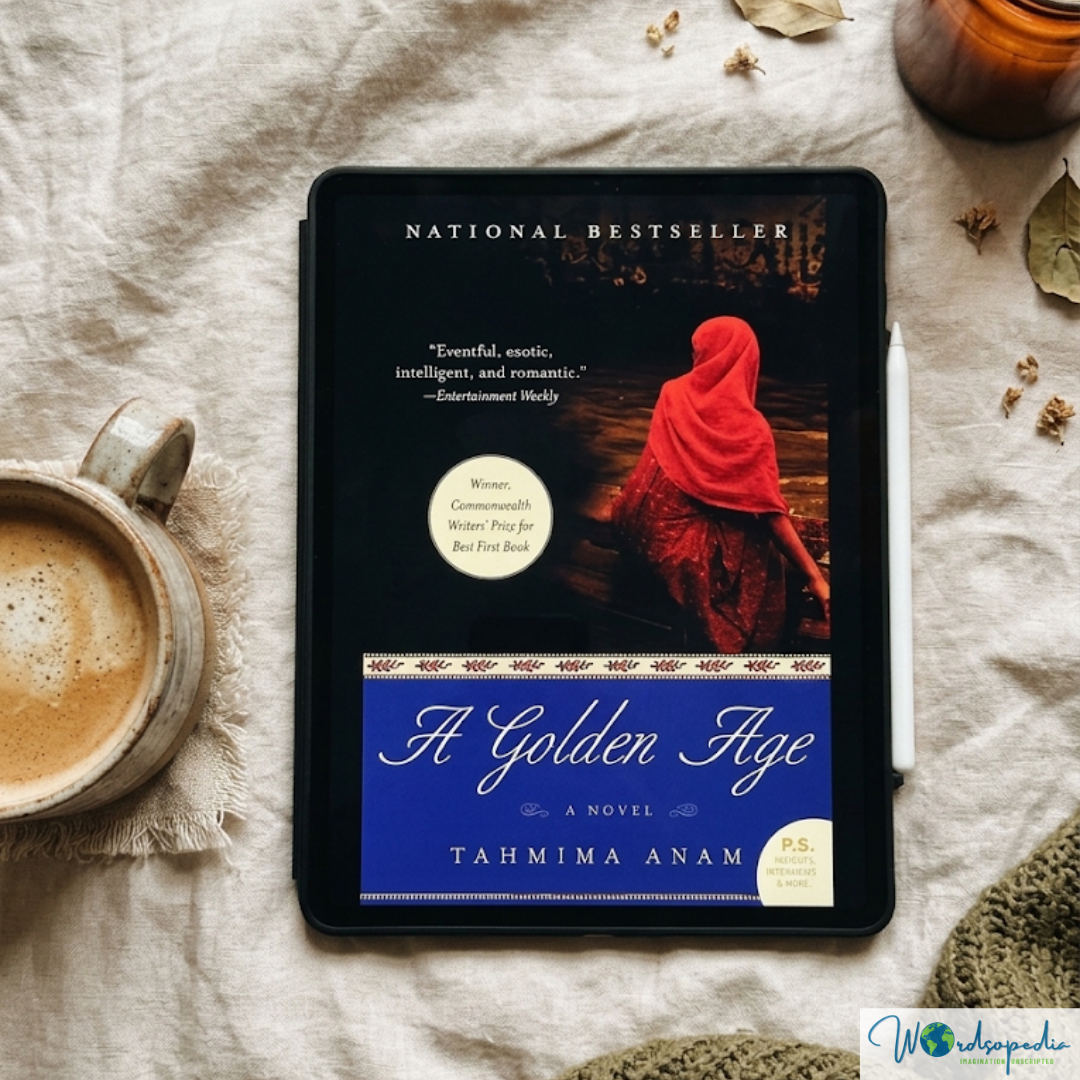
People often say you fall in love only once in a lifetime. But I humbly beg to disagree. I have no shame in admitting that I have fallen in love more than once, and I continue to do so with abandon. Just last week, I fell head over heels in love with Tahmima Anam. How could I not? A Golden Age is such a breathtaking, gorgeously penned novel.
Set against the harrowing backdrop of the 1971 Bangladesh Liberation War, it is at its heart a mother’s story—a woman who will cross any line to protect her children.Yet it is also a story of fierce patriotism, the devoted memory of a dead husband, unexpected romance, deep friendship,and the quiet weight of faith.
The moment I read that opening sentence—“Dear Husband, I lost our children today.”—I knew that this was going to be an unforgettable read.
⚡ The Quick Take
The Vibe: Intimate, emotionally charged, and poignant—a quiet domestic sanctuary colliding with the violent birth of a nation.
Best For: Readers who love deeply character-driven historical fiction, nuanced maternal portraits, and stories where personal lives eclipse geopolitical headlines.
Key Takeaway: A powerful testament to the messy, fierce, and unvarnished nature of a mother’s love, demonstrating that quiet domestic sacrifices can be just as revolutionary as taking up arms.
Wordsopedia Verdict: ⭐⭐⭐⭐½
What Is A Golden Age About?
The narrative begins in 1959, in erstwhile East Pakistan. Rehana Haque is left widowed and penniless, and in a devastating courtroom blow, her young children, Sohail and Maya, are taken from her and handed over to her affluent brother-in-law in Lahore. But Rehana is not a helpless, tragic widow destined to fade away. She refuses to surrender.Through sheer grit, quiet determination, and desperate bargains, she claws them back to Dhaka, keeping the harrowing cost of their reunion tucked away in her heart.
A decade later, in March 1971, her home is filled with the laughter and energy of grown children. But outside its walls, the country is caught in a terrible tempest. War and conflict are casting a dark net over the land; the people and the nation stand divided on what is best for all. Sohail, Maya, and countless young students rise to the occasion, determined to protect the Bengali spirit and fight for freedom.
Before Rehana can even process the danger, the rebellion arrives at her doorstep. She is suddenly caught between fractured loyalties. Maya drapes herself in austere white sarees, questioning her mother’s hesitation and inability to speak out boldly for Bangladesh. Sohail, patient and thoughtful, tries to broker peace between them while slipping deeper into the guerrilla struggle.
For Rehana, who spent her formative years speaking Urdu and whose own sisters reside across the border in West Pakistan, the concept of national identity is tangled. Yet when the student resistance knocks on her door, she finds support from trusted friends, almost loses her children only to fight for them again, discovers an unexpected spark of romance,and finally confronts which side of history she must stand on.
Characterisation and Arcs
What makes this novel utterly captivating is the sheer authenticity of its characters. Tahmima Anam resists the temptation to write saintly caricatures.
Rehana is an extraordinarily rendered protagonist. She is not a textbook revolutionary waving a flag on a podium; her patriotism is born entirely out of maternal instinct. Her children are her country. Her internal arc—from a woman desperate to preserve the safety of her domestic bubble to someone witnessing her son digging trenches in her rose garden to hide guns—is breathtakingly organic. She is flawed, fiercely protective, prone to jealousy, yet infinitely courageous.
The contrast between Maya and Sohail adds immense texture to the family dynamic. Maya is raw, ideological fire—the kind of youth who views the world in uncompromising black and white, demanding absolute solidarity from everyone around her. Sohail, on the other hand, is the soul of quiet conviction, bearing the weight of leadership with a haunting,patient melancholy. Their interactions feel achingly real, capturing the friction between generations caught inside a brewing revolution.
Setting and Atmosphere
Anam’s portrayal of Dhaka in 1971 is vivid and sensory. I didn’t just read about the city and the fires burning in its womb; I lived inside it. The humid air before the monsoons, the fragrance of the champa flowers in Rehana’s garden, the crackle of radio broadcasts, and the sudden, suffocating terror of military curfews—every element is painted with crisp evocative detail.
The contrast between the sanctuary of Rehana’s home and the brutal reality of Pakistani army crackdowns just beyond the gate makes the stakes feel intensely personal. Anam understands that war is rarely experienced as a series of grand military strategies; for ordinary civilians, it is felt through empty pantry shelves,whispered warnings behind drawn curtains, and bloodied bandages drying on laundry lines.
Themes and Layering
Beneath the historical framework of the 1971 war lies a profound exploration of identity, belonging, and language.Rehana’s mother tongue is Urdu—the very language associated with the oppressor in the eyes of the Bengali nationalists.This linguistic and cultural displacement adds a fascinating layer of tension. Can a woman who loves the cadence of Urdu belong to the heart of Bangladesh? Anam handles this dilemma with exceptional sensitivity.
Equally compelling is the novel’s examination of faith and morality during wartime. As the violence escalates, traditional notions of right and wrong begin to fray. Rehana makes compromises and moral choices that test her soul, proving that survival during war is never tidy or pure.
The Craft of Storytelling
The pacing is deliberate, meditative, and beautifully controlled. Anam gives the early chapters room to breathe, anchoring us securely in Rehana’s domestic life before gradually tightening the noose of political tension. The transition from peaceful domesticity to active war feels as inexorable and terrifying as it must have felt to those who lived through it.
The prose is elegant without ever being ostentatious. Anam knows when to linger on an intimate, poetic detail—like the touch of a hand or the sound of the wind through the veranda—and when to deliver an emotional gut-punch with stark,unadorned simplicity.
❖ The Highlights
➤ An Unforgettable Protagonist: Rehana Haque is one of the most richly developed, authentic mothers in contemporary South Asian literature.
➤ Emotional Resonance: The opening sentence grabs you by the throat, and the emotional momentum never lets go until the final line.
➤ Evocative Setting: The atmosphere of 1971 Dhaka—both its tranquil domestic corners and its terror-stricken streets—is brought vividly alive.
➤ Nuanced Politics: Explores the messy intersections of language, mother tongues, regional identity, and family loyalty without resorting to simple black-and-white tropes.
❖ The Hiccups
➤ Secondary Characters Could Use More Room: While Rehana and her children are rendered in full dimensional depth, a few supporting figures in the resistance movement felt slightly hurried in their development.
➤ Understated Historical Scale: Readers looking for sprawling military history or expansive battlefield chronicles might find the strictly domestic, intimate lens a touch narrow—though for me, this was precisely the book’s greatest strength.
A Golden Age is a triumph of storytelling. It captures the ache of loss, the raw terror of war, and the fierce, uncompromising pull of motherhood. Tahmima Anam has written a story that lingers long after you turn the last page, reminding us that home isn’t merely a piece of earth—it is the people we refuse to let go of.
Frequently Asked Questions
Is A Golden Age a standalone novel or part of a series?
It is the first installment in Tahmima Anam’s acclaimed Bengal Trilogy, followed by The Good Muslim and The Bones of Grace.
What is the central historical backdrop of the book?
The novel is set during the 1971 Bangladesh Liberation War (formerly East Pakistan), chronicling the struggle for independence from the vantage point of an ordinary family.
Who is the author, and what accolades did this book receive?
Tahmima Anam is a British-Bangladeshi author and anthropologist. A Golden Age won the 2008 Commonwealth Writers’ Prize for Best First Book and was shortlisted for the Guardian First Book Award.