
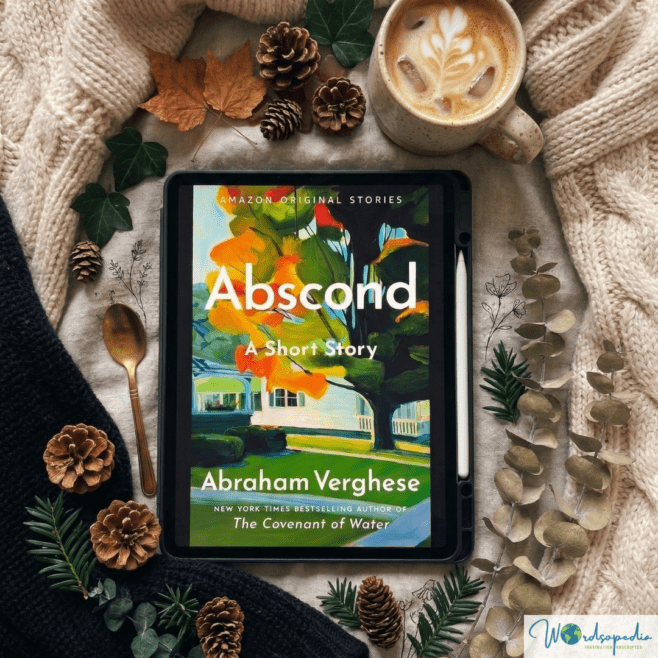
Abscond by Abraham Verghese is part of the Amazon Original Stories collection. At just 38 pages, this coming-of-age story about grief and loss is a quiet gut-punch — and proof that the best short reads don’t need length to leave a mark.
I have been hearing about The Covenant of Water for a while now — the kind of word-of-mouth that makes you feel genuinely left out. But committing to a 700-page tome is a different kind of decision entirely. Abscond felt like the right door in — a way to meet Verghese on his own terms before signing up for the longer journey. I am glad I knocked.
⚡ The Quick Take
The Vibe: Quiet, precise literary fiction with the slow burn of a summer afternoon that doesn’t know it’s ending.
Best For: Readers who love character-driven stories rooted in immigrant identity, family love, and grief.
Key Takeaway: Verghese writes with a physician’s precision and a poet’s restraint. In 38 pages, he fits a lifetime of feeling.
Wordsopedia Verdict: 4/5 ⭐⭐⭐⭐
What Is Abscond About?
Suburban New Jersey in 1967 is the backdrop of the immigrant dream made visible — manicured, aspirational, and just slightly at odds with the Indian household at the centre of it. Verghese uses the period with precision. This is not historical fiction that wears its era on its sleeve. The stillness of it — a pre-digital summer where a boy and his father can spend a whole afternoon on a tennis court without interruption — makes the rupture hit harder.
Thirteen-year-old Ravi Ramanathan lives with his Indian immigrant parents — a surgeon father who champions his tennis dreams and a mother who keeps the household rooted in tradition. Life is warm and predictable. Ravi chafes at the rituals he hasn’t yet learned to treasure. Then one ordinary afternoon, he comes home and finds that nothing will ever be ordinary again. What follows is a story about grief, about the weight of what we took for granted, and about growing up overnight.
The People In Ravi’s World
Ravi is thirteen, restless, and tennis-obsessed. He is caught between who his parents want him to be and who he is becoming — and then suddenly, he has no choice but to grow up.
His father is warm, encouraging, and gone too soon. His absence is what drives the second half of the story entirely.
His mother Rekha is the most quietly complex character here. Her grief turns inward. She leans on ritual — the very traditions Ravi once rolled his eyes at — and by the end, those same rituals mean something completely different.
And then there is Billy, Ravi’s best friend, who barely appears but says everything by saying nothing at all.
Narration, Pacing, and Story Arc
The story is told in close third-person, staying tight inside Ravi’s confusion without losing the author’s steadying hand overhead. The narration never over-explains. It trusts you to sit with discomfort and feel what Ravi cannot yet articulate.
Ravi’s arc is the quiet engine of the story. He starts out as a boy who takes everything for granted — his father’s warmth, his mother’s rituals, the easy rhythm of a summer that seems like it will last forever. By the end, he is someone else entirely. The shift is not loud. It happens in small moments, in silences, in the way he looks at his mother differently. Rekha’s arc runs parallel — from a woman holding everything together to one slowly learning what holding together actually costs. The two of them move through grief at different speeds, and watching those speeds eventually meet is what gives the story its emotional core.
The pacing in the first half is one of the story’s greatest strengths — slow, golden, unhurried. When the pivot comes, it arrives without warning, which is exactly why it works. The story arc follows a clean three-beat structure — ordinary life, rupture, tentative reconstruction. The first beat is the most beautifully rendered. The third is where the story is most rushed, closing before the emotional weight of the middle has fully settled.
The Writing
Verghese’s writing is precise and deeply sensory. He has a physician’s eye for detail, and every sentence earns its place. The author packs so much into so few pages, and that too with control and feeling. Fans of his longer work — The Covenant of Water and Cutting for Stone — will recognise the voice immediately. For those coming to Verghese for the first time, this is as good an introduction as any.
There is a line that stopped me completely:
He wanted to retreat to a time before he knew his father, a time when he was buffered from the world and its sorrows by his mother, spared any sound but the drumbeat of her heart, a time when memory had not existed, and so loss could not.
And this one, about Billy:
Billy had offered Ravi the thing he most needed: his quiet, silent presence.
❖ The Highlights
➤ The writing: Precise, poetic, and never overdone — concentrated and controlled throughout.
➤ The grief: Rendered with raw honesty and remarkable restraint.
➤ The setting: Suburban New Jersey 1967 used with quiet precision — period without performance.
➤ The narration: Close third-person that stays honest and never over explains.
➤ The characters: Fully alive in very little space — especially the father, Rekha, and Billy.
➤ The pacing: The slow first half makes the pivot land exactly as hard as it should.
❖ The Hiccups
➤ The ending: Closes a beat too soon — the third act needed more room.
➤ Ravi’s transformation: Believable but slightly rushed given the short format.
➤ The short form as constraint: You occasionally sense the story has more to give than its page count allows.
Abscond is sad, precise, and quietly beautiful. It deals with grief, identity, friendship, and the particular ache of growing up too fast — and it does all of this in under forty pages. What stays with me is not the plot. It is those two lines. Verghese earns his memorability in sentences, not in spectacle.
If you have been putting off The Covenant of Water the way I have, start here. This is the right door in. Highly recommended.
Frequently Asked Questions
- Is Abscond by Abraham Verghese worth reading? Yes — especially if you enjoy quiet, literary short fiction. At 38 pages it is a fast read, but the emotional impact stays with you much longer.
- How long is Abscond? 38 pages. It is part of the Amazon Original Stories collection and is available as a Kindle ebook and audiobook.
- Is Abscond connected to The Covenant of Water or Cutting for Stone? No — it is a standalone short story. But it shares Verghese’s signature sensibility: immigrant family life, grief, and deeply observant prose. If you have not read his longer work, this is the perfect starting point.
- What is Abscond about? A thirteen-year-old Indian-American boy in 1967 New Jersey whose ordinary summer is upended by sudden loss. It is a coming-of-age story about grief, family, and growing up overnight.
- Does Abscond have trigger warnings? Yes — parental death, sudden loss, grief, and mourning.
If you enjoyed this review, you might also like:
If you liked Abscond, you might also enjoy:
- Interpreter of Maladies by Jhumpa Lahiri
- The Namesake by Jhumpa Lahiri
- The Covenant of Water by Abraham Verghese
This review reflects my honest and voluntary opinion.